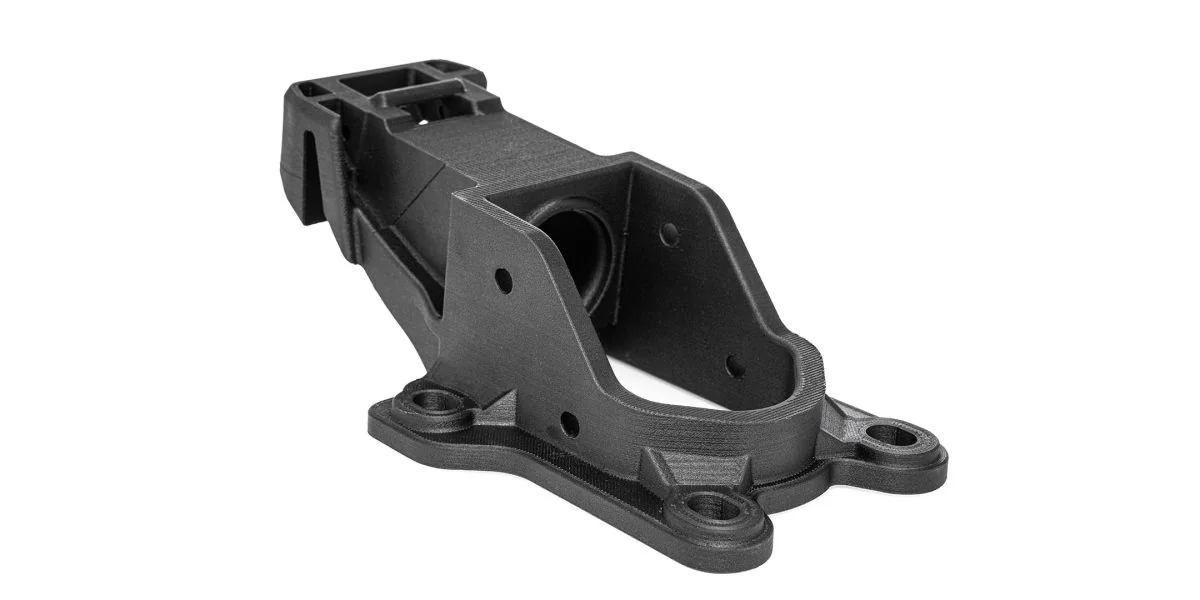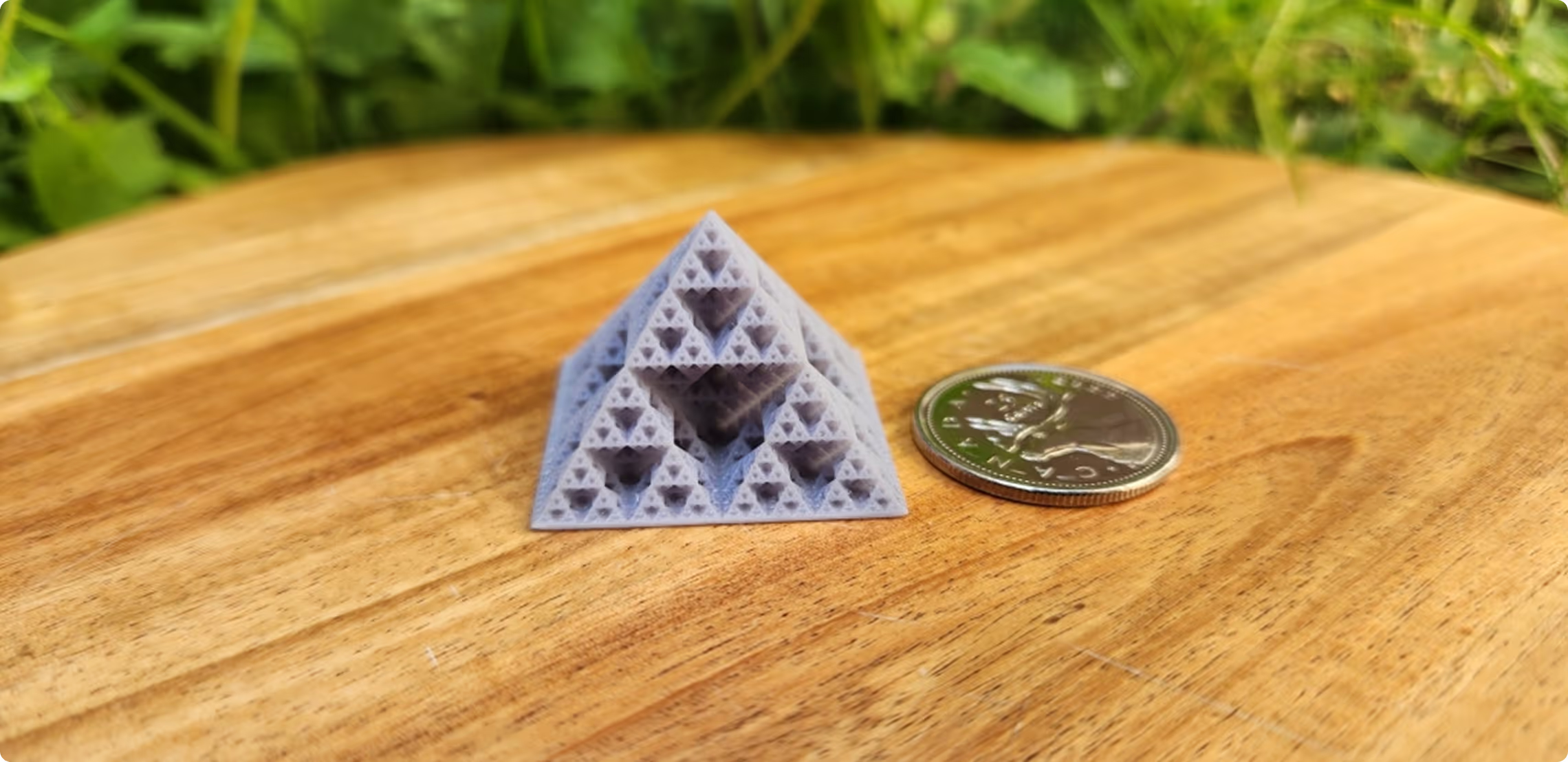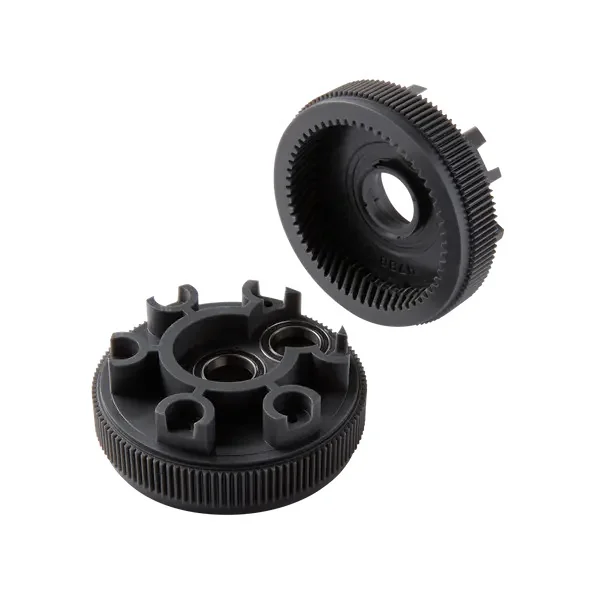
Imagine a plastic you could soak in hydrochloric acid, bake at 150°C, leave outside for forty years, and watch it come out basically unchanged. That plastic exists. It's called PVDF, and Morin 3D is now one of the only 3D printing services in Canada that stocks and prints it.
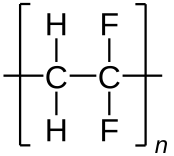
PVDF (polyvinylidene fluoride) is a fluoropolymer — a polymer with fluorine atoms bonded along its carbon backbone. Those carbon–fluorine bonds are some of the strongest in organic chemistry, and they're the source of everything interesting about this material. Arkema sells the leading grades under the brand name Kynar®, and PVDF comes from the same family as PTFE (Teflon) and FEP. But where PTFE is famously unprintable on FDM, PVDF melts cleanly around 170°C and can be extruded through a 3D printer like any other engineering thermoplastic.
That matters, because very few Canadian print shops offer a dedicated PVDF printing service. If you've needed a chemically resistant part printed in Canada, you've usually had to look south of the border or settle for a lower-spec material. That's the gap we're filling.
The Chemical Resistance Is Ridiculous
This is the main event. At ambient temperature, PVDF shrugs off:
- Most strong mineral acids — including hydrochloric, nitric, and sulfuric (even at elevated concentrations)
- Halogens like chlorine and bromine
- Chlorinated and halogenated solvents
- Aliphatic and aromatic hydrocarbons
- Alcohols, salts, and most oxidizers
- Basic solutions up to pH 12 for the homopolymer and pH 13.5 for copolymer grades
In plain terms: if your part lives in a chemical environment that would destroy ABS, PETG, or nylon, PVDF will generally sit in it without losing strength, dimension, or surface integrity.
Where PVDF Runs Into Trouble
PVDF isn't invincible, and it's worth knowing what actually bothers it before you spec a part:
- Strong bases at high concentration — hot caustic and primary/secondary amines can attack it
- Ketones — acetone and MEK will swell or dissolve it
- Esters and polar aprotic solvents — DMSO, DMF, and NMP are common offenders
- Fuming sulfuric acid (oleum) and a few other exotic reagents
If your process involves concentrated acetone or hot caustic, a different material is a better fit. For essentially everything else corrosive, PVDF is the right call.
Beyond Chemical Resistance
Chemical resistance is the headline, but PVDF earns its keep on several other properties too:
Properties That Come Along For The Ride
- Heat: 150°C continuous service rating. Arkema has tested Kynar® at 150°C for ten years in air with no detectable thermal or oxidative degradation.
- Flame: naturally UL 94 V-0 with a Limiting Oxygen Index around 43%. It does not want to burn, and it produces very little smoke if it does.
- UV & weather: Kynar 500® is the coating on high-end building facades because it still looks fresh after 40-year Florida outdoor exposure tests.
- Moisture: water absorption around 0.03%. It doesn't care about humidity, steam, or immersion.
- Piezoelectric: PVDF generates a voltage when mechanically stressed, which is why it shows up as the sensing element in hydrophones, strain sensors, and some medical ultrasound transducers.
Where PVDF Goes to Work
- Chemical processing: valve bodies, pump components, pipe fittings, tank liners, and spray nozzles in plants handling aggressive acids and halogens.
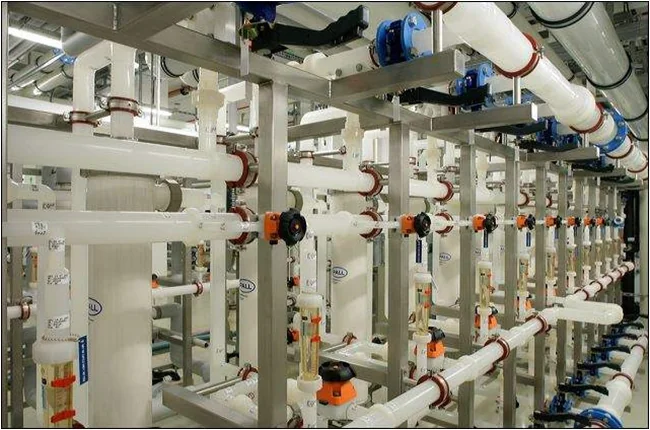
- Semiconductor fab: ultra-pure water (UPW) piping, where any contamination means scrap wafers. That's the installation in the photo above.
- Lithium-ion batteries: PVDF is the polymer binder gluing the cathode together in most Li-ion cells on the planet.
- Architectural coatings: that skyscraper cladding that still looks new after three decades? Often a Kynar-based finish.
- Solar: PVDF films are widely used as photovoltaic backsheet materials for their UV stability.
- Wire & cable: plenum-rated jackets because of the low smoke generation.
Printing PVDF Isn't Easy
PVDF is a semicrystalline fluoropolymer that wants to warp as it solidifies, and the nozzle runs hot — typically 250-260°C. It's finicky about bed adhesion and needs a controlled first-layer setup. In exchange for that extra effort, you get a part that will genuinely outlive the equipment around it.
Our filament of choice is Fluorinar-C™ from Nile Polymers, a Kynar®-based PVDF copolymer. We went with the copolymer grade specifically because it prints with far less warping and much better dimensional accuracy than homopolymer PVDF, which historically has been the bottleneck for reliable PVDF 3D printing. Fluorinar-C™ holds its shape without needing a heated chamber and stays flat on the build plate instead of curling off as the part cools — which means we can actually deliver parts to spec in Canada rather than chasing tolerances. Nile were the first company in the world to commercialize a PVDF print filament, and their chemistry is a big part of what made reliable PVDF printing feasible outside of an injection-molding shop.
Fluorinar-C™ keeps PVDF's defining strengths — full chemical resistance, low water absorption, UV stability, and inherent flame retardancy — and is rated for continuous service up to about 130°C. If you need the full 150°C rating, talk to us and we'll discuss a homopolymer-based option.
Safety: The One Real Caveat
PVDF is almost boringly safe under normal service and handling. It's non-toxic, doesn't leach, and is used widely in food-contact, potable-water, and medical applications. It has one important failure mode, though: push it past roughly 350°C and it begins to thermally decompose, releasing hydrogen fluoride (HF) — a gas that's acutely toxic and extremely corrosive to human tissue. This is non-negotiable to plan around.
Here's how we handle it in our shop so our customers don't have to worry about it:
- Hard nozzle temperature cap: our PVDF print profiles run at 250–260°C with a firmware-enforced ceiling well below the 290°C safety limit Nile publishes — and nowhere near the ~375°C where Arkema measures meaningful HF evolution.
- Dedicated fume extraction: PVDF prints run on a printer with active HEPA + activated-carbon filtration and exhaust ventilation, isolated from shared areas.
- No hot removal: failed prints and purge material are never torched, melted off, or reground. They're snapped off cold and disposed of with our plastics waste — never incinerated on-site.
- Self-limiting behaviour: unlike PVC, PVDF will stop decomposing as soon as heat is removed (this is documented by Arkema). If something goes wrong, killing power to the hotend brings it right back to safe.
- Operator training & PPE: anyone running our PVDF printer is trained on the HF risk, has access to calcium gluconate gel, and knows the emergency procedure.
Printed, finished PVDF parts are completely safe to handle and use — the HF risk exists only during a thermal runaway that we design our process to prevent.
Is PVDF Right For Your Part?
PVDF is overkill for most jobs — and that's exactly the point. If PETG or ABS can do it, use those. But when your part has to survive a process chemical, sit in UV for a decade, pass plenum smoke tests, or work in a semiconductor clean line, PVDF earns its keep. That's the niche we stock it for.
If you've been searching for PVDF 3D printing in Canada, a Kynar® 3D printing service, or a domestic source of chemically resistant printed parts — that's us. We ship across Canada from Victoria, BC, with the usual fast turnaround Morin 3D is known for.
Got a chemical-service part in mind? Upload your file for a quote, or get in touch and we'll help you work out whether PVDF is the right material for the job.