Every engineer who's worked with high-performance plastics knows PEEK. It's the material you spec when nothing else will do: extreme temperatures, aggressive chemicals, and continuous mechanical load. PEEK handles it all.
It also costs a fortune. PEEK filament runs $500-800 per kilogram. Printing it requires specialized heated chambers, hardened components, and expertise. For many applications, PEEK pricing simply doesn't pencil out.
Enter PPS-CF: Polyphenylene Sulfide reinforced with carbon fiber. It delivers roughly 90% of PEEK's performance at a fraction of the cost. We call it the working man's PEEK.
What Makes PEEK Special (and Expensive)
PEEK (Polyether Ether Ketone) occupies the top tier of engineering thermoplastics. Its properties are genuinely remarkable:
- Continuous use temperature up to 250°C
- Excellent chemical resistance (acids, bases, solvents)
- High mechanical strength that persists at elevated temperatures
- Inherent flame resistance
- FDA compliant and biocompatible grades available
For aerospace, medical implants, and oil & gas downhole applications, PEEK is often the only option. But its premium status comes with premium pricing and processing challenges.
PPS-CF: The Practical Alternative
PPS (Polyphenylene Sulfide) reinforced with carbon fiber shares many of PEEK's strengths while being significantly more accessible:
PPS-CF Properties
- Heat Deflection: 270°C (often exceeds PEEK)
- Continuous Use: Up to 200°C
- Chemical Resistance: Excellent against fuels, oils, and many solvents
- Tensile Strength: 110+ MPa (comparable to PEEK-CF)
- Dimensional Stability: Minimal warping and excellent tolerances
- Cost: Approximately 1/4 to 1/3 of PEEK
Head-to-Head Comparison
Here's how the materials stack up for common selection criteria:
| Property | PEEK-CF | PPS-CF |
|---|---|---|
| Continuous Use Temp | 250°C | 200°C |
| Heat Deflection | ~280°C | ~270°C |
| Tensile Strength | 120+ MPa | 110+ MPa |
| Chemical Resistance | Excellent | Excellent |
| Material Cost | $$$$$ | $$ |
| Print Complexity | Very High | Moderate |
When to Choose PPS-CF
PPS-CF excels in applications that need high-performance properties but don't require PEEK's absolute extremes:
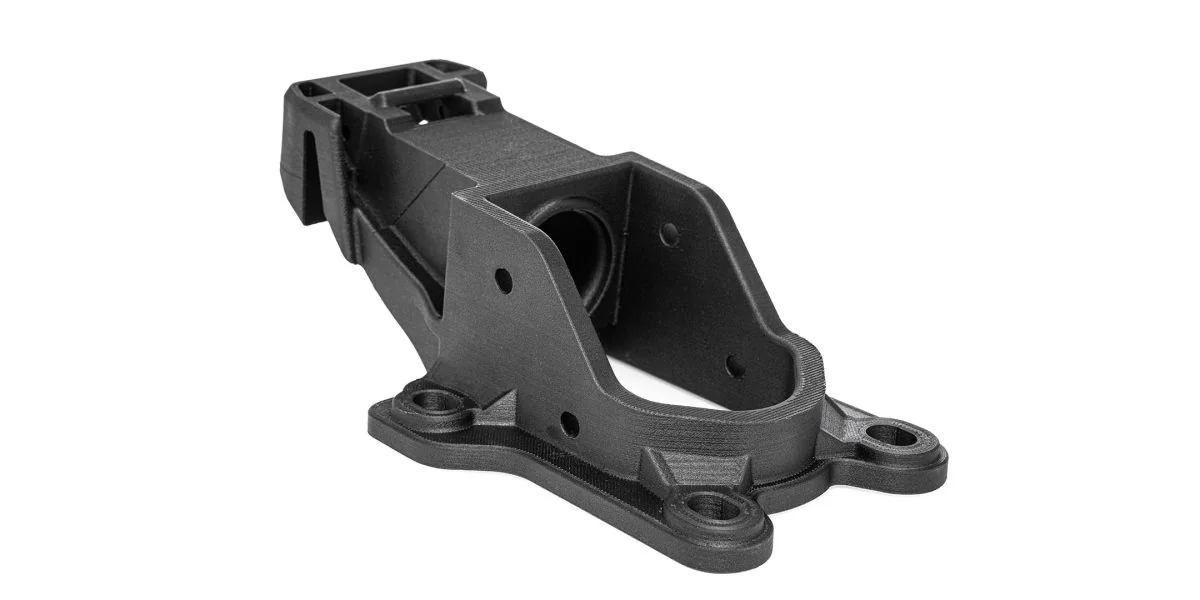
- Under-hood automotive: Sensor housings, electrical connectors, intake components
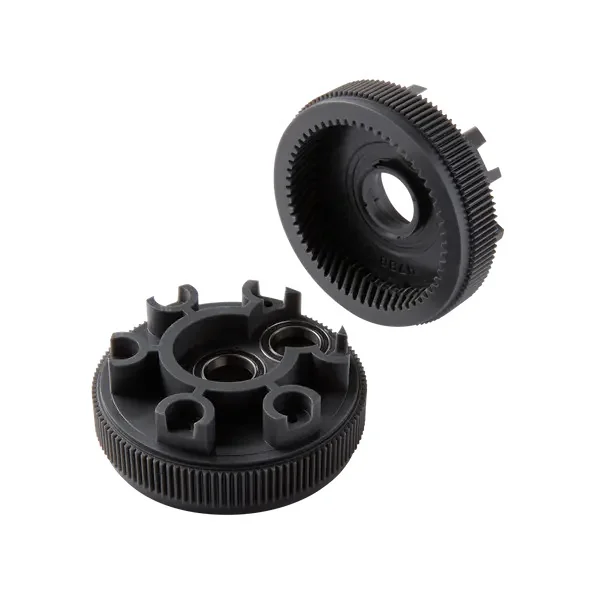
- Industrial equipment: Bearing cages, pump components, wear surfaces
- Electronics: Structural components near heat sources
- Chemical processing: Flow components, valve bodies, fixtures
- Tooling & fixtures: Production jigs that see elevated temperatures
When You Actually Need PEEK
There are applications where PEEK remains the right choice:
- Medical implants: Biocompatibility and regulatory approval
- Aerospace: Certified materials for flight-critical applications
- Extreme temperatures: Sustained operation above 200°C
- FDA food contact: Some specialized regulatory requirements
- Radiation resistance: Nuclear and space applications
For these applications, PEEK's premium is justified. For everything else, consider whether PPS-CF delivers what you actually need at a fraction of the cost.
"We were specing PEEK for sensor housings that would see 180°C in service. PPS-CF handles that easily and saved us about 60% on material costs. The parts have been in production for two years without issues."
– Victoria-area equipment manufacturer
Printing PPS-CF
While PPS-CF requires a heated chamber and hardened nozzle, it's significantly more forgiving than PEEK. Key considerations:
- Bed temperature: 100-120°C
- Chamber temperature: 60-80°C (not the 150°C+ PEEK requires)
- Nozzle: Hardened steel or ruby-tipped (carbon fiber is abrasive)
- Print speed: Slower than standard materials, but faster than PEEK
- Annealing: Often beneficial for maximum heat resistance
Get Started
If you've been pricing PEEK and wondering if there's a more practical alternative, let's talk. We can review your application requirements and recommend the right material, whether that's PPS-CF, PEEK, or something else entirely.
Upload your files for a quote, or contact us to discuss your high-temperature application.